
Reads every flow
in your system.Finds the compute
you never needed.
Ascend’s models are trained for one job – recognizing work your code does and never needed to do. They rank what they find by what it costs in production, write the fix, and prove behavior holds. Everything runs on your infrastructure.

How it works
Continuous code optimization.
End to end.
01
Map
Plug and play. Ascend maps the repositories you connect and identifies every entry point, path and exit point.
02
Reason over flows
Not functions, not snippets. The same operation can be necessary on one path and free work on another, and only the whole flow tells you which.
03
A prioritized bank
of findings
Every opportunity is named, explained and ranked by what it costs where it runs.
04
Act, three ways
Open a ticket, hand a ready-made prompt to your coding agent, or let Auto-fix write the fix and open the pull request.
Two tracks, running at once
Stop the new waste
Ascend scans every pull request you open and catches the waste before it merges, let alone before it reaches production.
Clear the legacy, at your pace
The same scan runs across what you already have. Years of inefficiencies nobody had the capacity to chase.
What it looks for
100+ optimization patterns.
And counting.
Built on 25+ years of deep software optimization expertise, Ascend uncovers unnecessary computation hidden across entire code flows. Its growing library of 100+ optimization patterns reveals findings no other tool finds.
95%
accuracy
One opportunity.
The full picture.
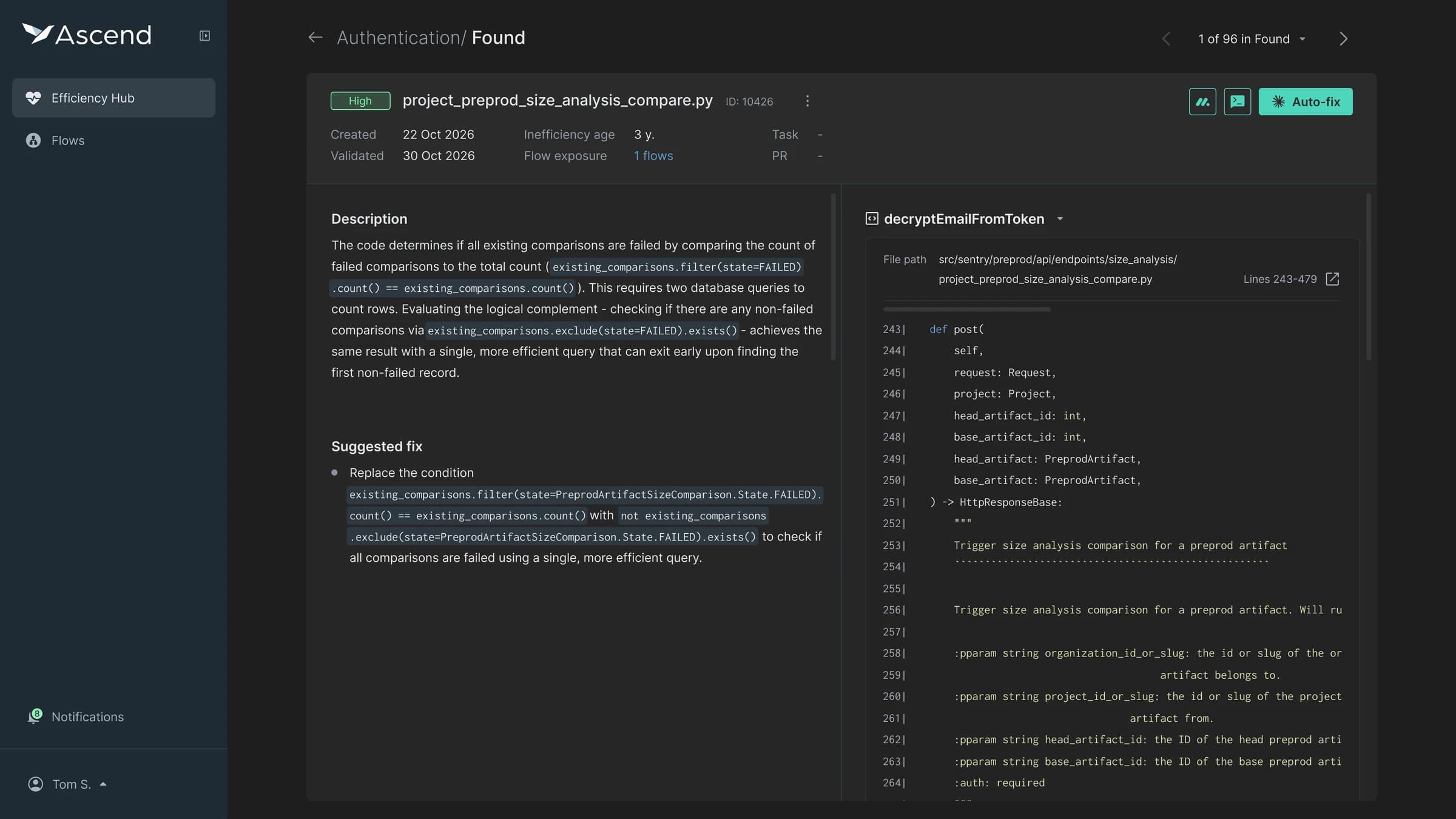
See exactly where the inefficiency occurs, which flows are affected, and what makes it worth fixing. Each opportunity brings together the technical context, impact assessment, and recommended next steps in one place.
With Auto-fix, we turn that insight into a targeted code fix and a pull request ready for merge.
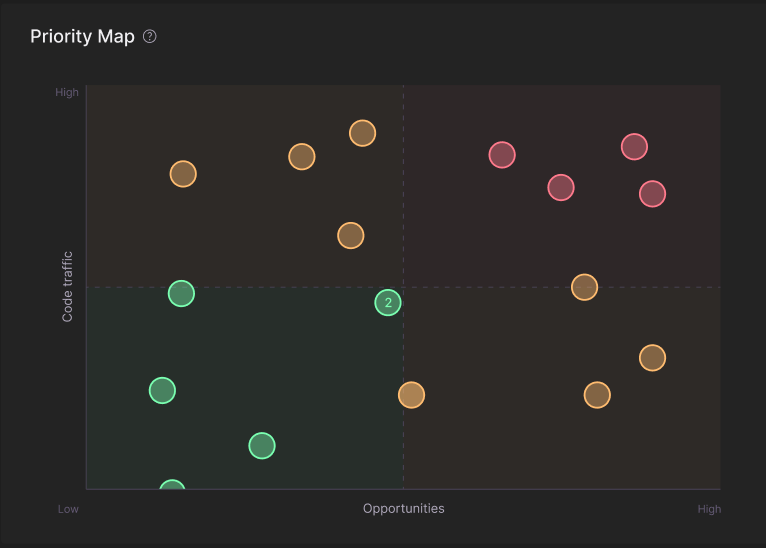
Prioritized by impact.
Ascend combines deep static code analysis, flow-level insights, and production data from APM tools to identify the optimization findings that matter most.
Heatmap
Highlights where complexity and optimization findings are concentrated across the codebase.
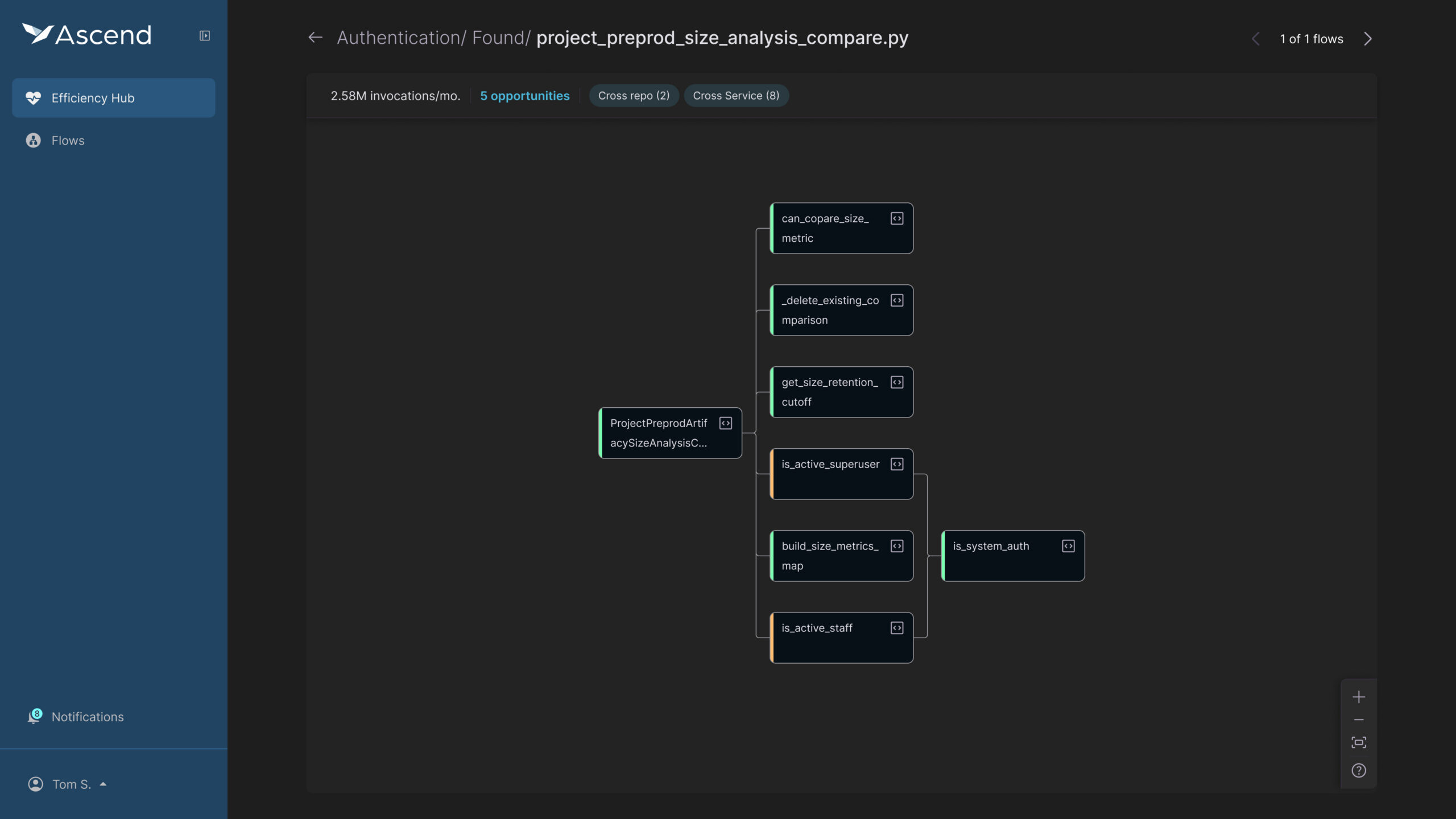
Flow exposure
Shows how widely affected code is shared across different flows.
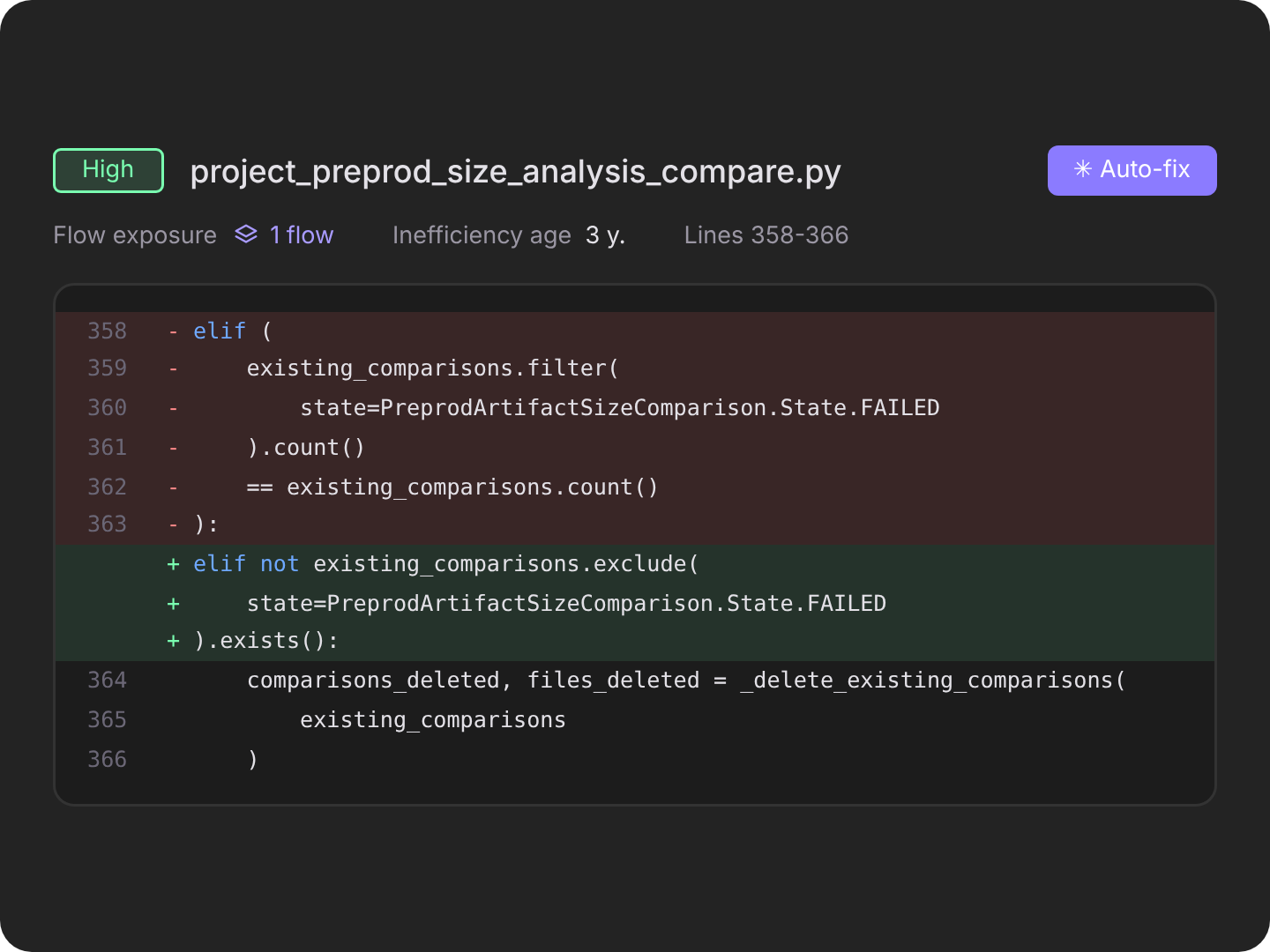
Optimization potential
Evaluates the computational work that could be eliminated.
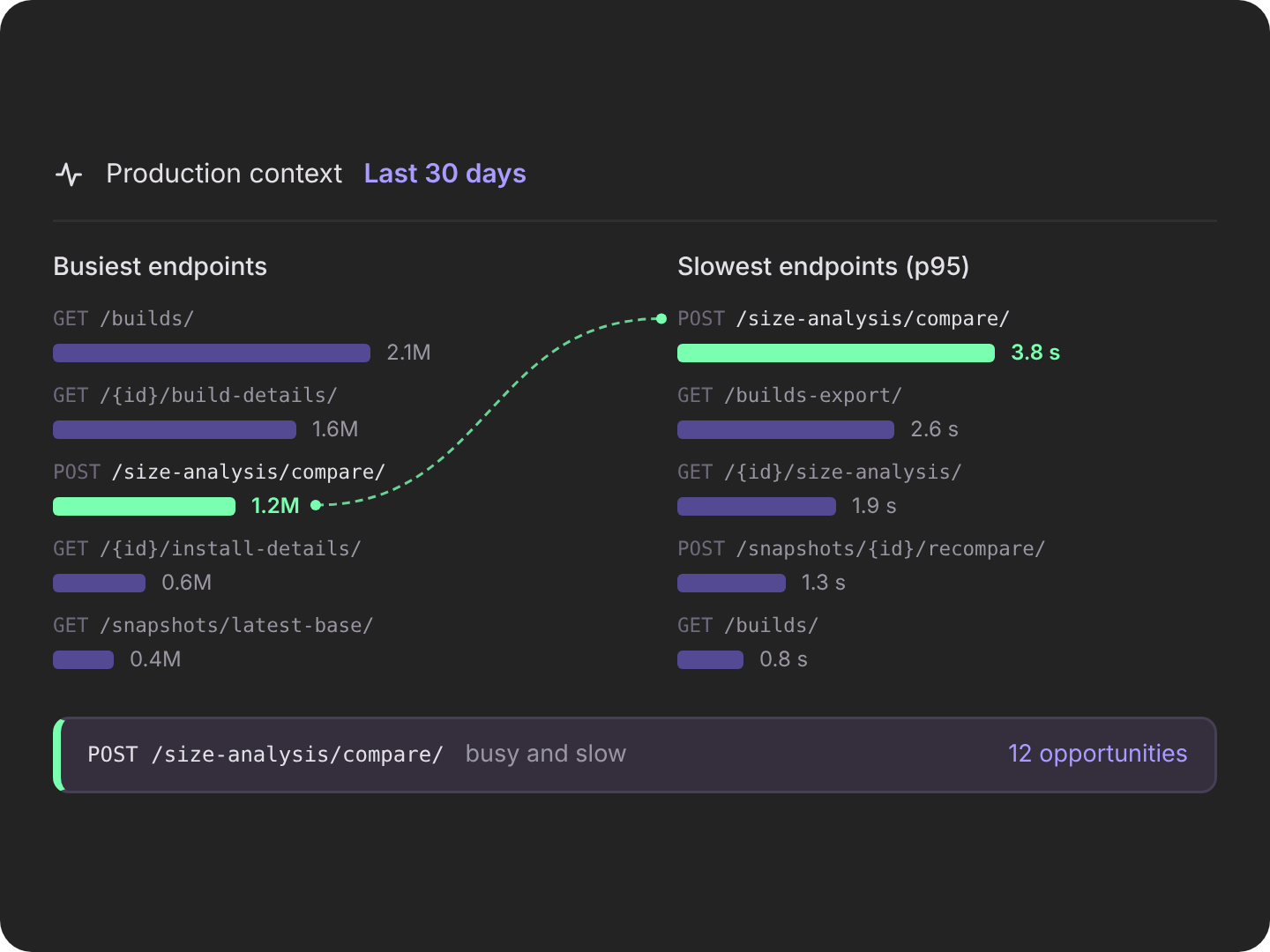
Production context
Uses APM data to understand execution frequency and identify high-impact paths.
The models
An optimization expert,
running on your infrastructure
Ascend’s proprietary AI models are fine-tuned for one job: uncovering
computational waste across your codebase.


Purpose-built intelligence
Specialized in identifying optimization opportunities that general-purpose AI models are not designed to find.

Beyond language and syntax
Reasons about code at the logical level, using a dedicated mapping layer to work across programming languages.

Runs inside your network
Fully self-hosted, keeping your source code and metadata within your infrastructure.

No external dependency
No third-party models, external AI calls, or token-based costs.
Why language matters
less than you would think
Ascend looks for waste at the logical level, and an operation the code never needed is waste in any language. The language is syntax. A mapping layer makes a codebase legible to the models, and that layer is what gets adapted to support new languages.
Java
Python
Go
C#
Node.js
Kotlin
C++
SQL
Rust

A mapping layer
The models
Runs where your code lives
Your infrastructure. Your network.

Source code
Never leaves your environment
Metadata
Never leaves either. Not file names, not structure, not findings
Outbound traffic
None in the analysis path
Third-party models
None. The models are ours and run on your machines
Token cost
None. Nothing is metered
Production
Never touched. Static analysis against the repository
Install
Terraform into your own cloud account or on-premises, soon AWS marketplace
What it plugs into
Languages
Java
C#
Python
Go
Node.js
Kotlin
C++
SQL
Rust
more soon
Repositories
GitHub
GitLab
Bitbucket
including self-hosted
CI/CD
Runs as a check on every pull request
Coding agents
Cursor
Claude Code
Copilot
Codex
Ticketing
Jira
Monday
other task management tools
APM
Datadog
New Relic
Coralogix
OTel
read-only
Using a different stack?
We continuously expand our language and integration support based on customer needs.
Works with what you already run
Next to your stack. Not on top of it.
| What you already run | What it does | What it cannot reach |
|---|---|---|
| FinOps and cost visibility | Shows where the money went, by team and service | Whether the work was needed at all |
| Rightsizing and autoscaling | Matches the machines you rent to the load you generate | The load itself |
| APM and profilers | Runtime symptoms like latency and error rate | Symptomless waste, root cause, newly shipped code |
| Code review, human or AI | Catches correctness, security and style | What the logic costs to run |
Ascend is additive. If you have already captured the big savings in infrastructure, this is the next layer.

Questions
The technical questions
Which languages do you support?
Ascend currently supports Java, C#, Python, Go, Node.js, Kotlin, C++, SQL and Rust. Our language coverage is continuously expanding, driven by customer needs and evolving technology stacks.
Using a different language? Let us know.
How does Ascend ensure high-quality opportunities?
Built on 25+ years of deep software optimization expertise, Ascend uncovers unnecessary computation hidden across entire code flows. Its growing library of 100+ optimization patterns reveals findings no other tool finds.
How can we trust the fixes Ascend generates?
They rank what they find by what it costs in production, write the fix, and prove behavior holds. Everything runs on your infrastructure.
Why not just use a general-purpose AI coding agent?
Specialized in identifying optimization opportunities that general-purpose AI models are not designed to find.
Does it run against production?
Never touched. Static analysis against the repository.
Does it work on legacy code?
The same scan runs across what you already have. Years of inefficiencies nobody had the capacity to chase.
How easy is it to get started?
Plug and play. Ascend maps the repositories you connect and identifies every entry point, path and exit point.

One repo. See for yourself.
Point Ascend at one repository and it returns the findings, named and ranked by the savings each fix provides.